Friday, February 18, 2011

Pie, Pie My Darling

I've been reading Pie Any Means Necessary: The Biotic Baking Brigade Cookbook which I got through my Friends of AK Press deal.  Despite the title, this is not a cookbook, it's a history book and activist guideline for how to cut people down to size with a well-timed pie to the face.  As someone who has spent almost his entire life pranking people, I appreciate it as those in power deserve to be pied every once in a while.  (The fact is, many of them need something even more extreme as the decisions they make often effect people's lives in negative ways and I'm a firm believer in an eye for an eye.)

Politicians, newscasters, actors -- nobody is immune from these antics.  To read the first-hand accounts of the pie tossers and how they get by security is nothing short of amazing.  Reading the reasons why they do it makes me think their targets should be thankful they came armed only with pies and an agenda and not a Luger.  From what I see, the people pied deserve it.  When you press for clearcutting forests or want states to be get rid of libraries and give those tax dollars to businesses instead, a face full of cream is about the best you can wish for.

The Middle East right now is a victim of threat by example.  Egypt set the example.  Other people have caught the fever and have started protesting, marching through the streets with fists raised.  In a sense, they have the same spirit as people like the Biotic Baking Brigade.  Their actions aren't as directed, but the desire to show those in power that their time has come is the same.  Reading this book (which I have not yet finished), is a good reminder of the importance of protest and pranks.  They can cause change, and if they don't, they still make you feel better.  You can either complain about your leaders or oust them.  Remember: if the only way an leader can justify itself (be it human or an agency of humans) is by force, it is no real leader and deserves to be dismantled.  Just because someone or something has a title doesn't mean it deserves it.  What it does deserve is a pie smack dab in its face.

A word of warning, though.  As I was reading the book I came across this disturbing essay title: Menstrual Pies!  Just seeing the title reminded me of a video I saw a few years ago, and the stomach churning feeling I got from it.  The essay is not what it seems, so I would not skip over it if you are reading the book, and nor would I put the book back on the shelf if you are thumbing through it at your local bookseller. 

If  you're in Wisconsin today, you know how nice it would feel to lob one of those pies at your union-hating Republican servants.  If you're in Libya, you may want a pie but probably need bullets.  Either way, the spirit of freedom and fairness is alive and well.  It is up to those who want such things to take them.  Your leaders won't give them to you, they must be snatched away from them.  This book reminds you that such a thing is possible.  Nobody is safe, and there are no exemptions.  It's a bit refreshing, quite honestly, like a an custard pie to face.

Monday, February 14, 2011

Borders

Eureka, California's Bayshore Mall has a Borders.  It's one of the mall's anchor stores.  Fifteen hours ago the Wall Street Journal reported that a bankruptcy filing could come within days.  It is predicted that many stores will close soon with more to follow later. 

I'm a fan of bookstores both franchise and independently owned.  The idea of any of them going under gives me a slight sense of dread.  Besides the lost jobs, there is the fact that for many these large chains are the only places to buy books.  Sure, you can get them at Target or Wal-Mart, but try finding a copy of Cannibal Killers there.  You won't.  The Borders disaster is just one more nail in the coffin, though I doubt physical books will disappear in my lifetime.  Access to them, however, will be harder to come by.

Many, but not all, independent bookstore owners are excited about the prospect of Borders going under.  The truth is, however, that bookstores both large and small act as feeder stores for the the other.  If you can't find what you are looking for in one store, you go to the other ... and usually end up seeing something else you want, too.  What the independents do better, though, is know their audience.  Borders tried to be all things to everyone (coffee!  CDs!  DVDs!), while the independents focused on books.  It's a good business plan, as I'm sure Borders is now kicking itself over.

If Borders goes out of business it won't save independent bookstores from themselves.  Instead, it will probably fuel online sales at places like Amazon.  The people who shop only at Borders and not their local independent bookstore do so for a reason.  Borders' closing will most likely only serve to drive those consumers online, and the independent bookstore will never see their business.

I'm usually very excited when a large franchise goes out of business.  (My fingers are still crossed over Blockbuster.)  Bookstores are the exception to that.  I have my complaints about Borders, but they are minor compared to the loss to the Eureka book-loving community.  We still would have plenty of local stores to shop at (many of them specialize strictly in used books, however), but when it comes to books, choice should be the rule and not the exception.  Large franchises and independents operating together offers that.  Take either away from the equation and the real loss is felt at the consumer level.

Saturday, February 5, 2011

Letters from George 5

George Hayduke, King of Revenge, author of books like Mayhem and Make 'Em Pay, exchanged plenty of mail in our time.  (Should make anyone think twice before crossing me.)  Here is another letter from George.  He is referencing photos I was going to use for an interview with him I was doing. 

The government stuff he is referencing is in regard to me asking him about ways to shut down the factory where I worked.  I had had enough of management's idiocy and was set to make life hard for them.  It should be noted that the factory is now out of business.  In time, all my enemies expire.

Enjoy the letter.


Hi Doug,

Thanks for the diverse AK47 poster ... appreciated that.  Yup!!  It made me laugh.  I will send copies of [sic] my politically wimpy friends.  Sorry about the photo.  I have enclosed one ... thought I did ... must be growing truly senile.  Damn!!  I am also sending an amusing poster for you.

Use either of my pictures ... the hat and beard are current, the other one is a few years back.  Help yourself.

Yes, I would help OSHA make the workplace safe.  There are other nebbie government agencies that enjoy dicking around too ... EPA, Human Relations Commission, DEA, etc.  Textiles?  Do they hire alien workers ... foreign folks?  Might want the INS to run a green card check.  The Dept of Health might want to check things, too.  Anyway, I will see if I can help out from here, too.

Cheers,
George

Friday, February 4, 2011

Letters from George 4

Author and agent of destruction George Hayduke sent me this long (for him) letter.  He answered one of my questions about some phone scam I since don't remember, and comment on the Mushacia tapes.  You may know the tape by it's better known name of The Jerky Boys, which came out officially a few years later.  Enjoy.


Lo Dougo,

Sorry about the hipster greeting ... it happens.

Looking forward to issue #8 [of my 'zine] ... yessir.  I hope the photos I sent to you got there by now.  I did send them!

Asked a couple of pals about Mushacia ... they never heard of him or the tapes.  You're right, he/they are hilarious.  I plan to pitch an appeal in this year's book to learn who he is and why.  Is it also OK if I list you, your name and your 'zine in the book ... as a thank you?

I asked two of my resident Ma Bell folks about your free phone call question.  They said NO.  They are our folks ... not Ma Bell ... so they don't lie.  I get much of my fuck Ma Bell stuff from them.

Looked through #7.  Gotta do it again, perhaps when I'm tired or less old.  It's sort of like what I did a thousand years ago.  I think.  Let me do it again.  Perhaps being stoned will help.  It's not you, Doug, it's me.  It's just too much to assimilate in one viewing.

Thank you, amigo.

Cheers,
George


I did get a mention in his book.

Monday, January 24, 2011

Letters from George 3

This is the third in a series of letters I received from author George Hayduke, who has written many prank/revenge books.  Enjoy.


Hi Doug,

Got your card.  It's too late to change address for the book listing.  Oh well ... keep the forwarding card active.

Central America is very hot and very wet ... I am back for the year now (well, until December).  I was there on legit business.  Hey, I gotta keep my day job, there's not enough $$$ in books to keep me fat and happy.  Now if I could sell a movie or two!!!

Looking forward to C.I.P #8.  Enclosed is a funny cartoon you should like.

Cheers,
George


I don't have the cartoon anymore, and I don't believe Hayduke went on to do any movies.

Sunday, December 26, 2010

Letters from George 2

Here's another letter from George Hayduke (see last post), who has probably written more books than you've read.

Dear Doug,

So, that's what a 'zine looks like.  I used to do those when I was in school ... kind of a joke for friends and as an in-house silliness for this local bar where we hung out.  Neat.  Yours is more graphic and obviously '90s.  Mine was more silly, rude and '50s.  Oh well ... interesting.  Thank you.

I also enjoyed your latest two ideas and YES, I will included them in my upcoming new books.  And, I appreciate your offer to include stuff from the 'zine.  I probably will.

All for now ... thanks again.

Cheers,
George


If I recall, he did include my prank/revenge ideas and mention the 'zine in his next book. 

Sunday, December 12, 2010

Letters from George 1

If you read any of my other blogs (I have about 33 of them), you'll know I've been reprinting letters I've received from people throughout my life.  Here is the first from author and revenge king George Hayduke, author of classics like Mayhem and Make 'Em Pay.  I have been mentioned in at least one of his books, I've interviewed him, and we used to exchange quite a few letters and other things.  I have no idea if he is still alive.

I have no idea when I got this letter.  If you are a Hayduke fan, I think you'll enjoy it.  If not, there may be no reason for you to read it.

"Hi Doug, 

Tough show on your pal. You will find that you will lose friends all of the time.  That's why you'll get more cynical.  The secret is to not let it happen to you!  Oh well ...

You get a copy of STEAL THIS BOOK by contacting used book stores in your nearest city ... which is, what, Philadelphia, Wilmington, Baltimore?  There are lots of such stores and they will find copies of old and out of print books for you.  Good luck, it's a neat book and I did get to know the man in the last years of his life.

I'll try to get the commercial tape of the crank calls.  That is one funny tape!!  Sorry you had a bad time in New Orleans.  I had some good times there and some VERY funny times!! Some involved cops, firearms, bad guys, hookers, foreign agents, wet stuff, and etc.  That was when I was much younger.

All for now ... I am really anxious to see C.I.P. #8/

Cheers,
George"

Celebrity Worship

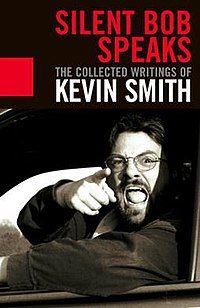
Yes, I am a fan of Kevin Smith.  There are things I don't like about him, though, and both are in full effect with his Silent Bob Speaks.  Don't get me wrong, I enjoyed the book.  I enjoyed the celebrity slams.  I did not, however, enjoy the celebrity worship (Tom Cruise) and masturbation over Jersey Girl.  (In all fairness, I did not see the movie.  It could be a good film.  It could be a great film.  It did not look like a film I would be interested in, however, so I didn't bother.  While I like Smith, I don't partake in everything he does.)

If you like comic books, the story of Kevin Smith always came across as, "One of us has made good."  Throughout his career he's come across as nice guy with whom you could sit and have a great conversation with.  He cares deeply about his friends, and hasn't seemed to let Hollywood get to his head ... too much.  (I'll never forgive him for the Daredevil/Bullseye disaster, but nor will I let that cloud his future or past work.)

His book was fairly light reading.  It was often funny.  Sometimes touching.  It wasn't an intellectual read.  It's not something that is going to change anyone's life.  It is read, digested and forgotten.  Worth the price?  Yes.  Worth the time?  No question.  Worth a reread?  Probably not. 

Not every book can be as deep as The Spanish Anarchists.  Not every book is meant to be.  Smith doesn't present himself as anything other than what he is: a guy who makes movies, writes comics and tells tales.  He's less guarded than many people in his position (but he's also no open vault), and that makes him refreshing to read.  I actually wished he burned more bridges, but it's his career versus my curiosity, and his career should win every time.

If you're a Smith fan, you probably already read this book.  If you aren't a Smith fan, this will change nothing, and I would actually advise you to stay away from it.  There's a reason you don't like the guy, and this book will confirm every one of those dislikes you have. 

Say what you'd like about the man, but he's far more entertaining that ninety percent of the other directors out there.

Sunday, November 21, 2010

Unexpected Surprise in the Most Unlikely of Places

The horror anthology Fears came out in 1983.  At that time I bought every horror book I could get my hands on.  This book was one of those acquisitions.

I loved it.  There were some excellent short stories in there.  The cover, understated and powerful, left me unprepared for just how good the book was going to be.  When yo have a roster that includes the likes of Chelsea Quinn Yarbro, Dennis Etchison, Joe R. Lansdale and George R. R. Martin you can't really go wrong. 

I loved the book, but when I moved to CA it was one of the ones I chose to leave behind.  Over the years I have thought about it.  I haven't really gone seeking it out because I have a lot of books I haven't read.  Why delve into a book I've read before when I have a stack of unopened potential treasures?

All that changed when one day I walked into the break room at my job and there it was, sitting on the table all alone, in a spot where people usually leave their unwanted books for others to pick up.  I could not believe my eyes or my luck.  Usually the books that were left behind were thrillers, romances, books on animal care, or spiritual stuff.  This was unexpected and, quite honestly, shocking.

I grabbed it.

I grabbed it, but also felt guilty about it.  Who would leave such a treasure.  I asked around, and someone finally said they had done it.  I asked if they had meant to leave it, and she confirmed that she did.  I was not going to argue.  This was a much better find than The Love Explosion.  (Though not nearly as funny.)

I imagine my original copy will someday show up in a package of stuff my mother has cleared out of storage.  I'll compare conditions and then make a decision on which to keep.  Until that day comes, however, I'm not letting this one out of my sight again.

Thursday, November 18, 2010

On Stephen King ...

Stephen King is rarely ever mentioned as "literature."  If anything, some critics seem to take his popularity as a sign that he is a lightweight.  Perhaps these criticisms are on the mark.  Perhaps they are the shadows of jealousy or disdain.  The two things that are hard to make an argument against is that his books sell, and they are fun to read.

King got me into writing with The Shining.  I was nine when I read it, and it scared the living shit out of me.  It also made me want to do the same thing to others.  Influential?  Yes, but if you read any of me fiction you'll be hard pressed to see those influences. 

My favorite King work (and I'll admit to not having read everything the man has ever produced) is Christine.  There is something about that story that strikes me as a perfect horror tale that is slightly experimental -- especially for King.  It will probably never be held in the same light as The Stand, but I think it is one of his best. 

Right now I'm reading the first part of The Green Mile.  I actually started buying this book in the serial format and then stopped for some odd reason, so I don't have all of them (they are fairly easy to find, so I'm not worried).  I'm enjoying it, but I'm not all very far into it.  From what I can see, it has the usual King hallmarks, and while that's not a bad thing, it is part of the problem with his work.

King has a habit of presenting many of the same types of characters over and over.  All with their own little quirks.  This irritates a lot of people ... including me sometimes.  Life, however, is a lot like that.  You encounter many of the same types of people day in and day out, each with their unique character features, which is often the only way to tell them apart from one another.  King is mirroring reality, but people don't read King's work to take in a dose of the outside world.  They read it to escape it, and therefore their criticisms may be sound.

The older I got, the more I appreciated his non-fiction work.  Reading his takes on writing is an endless source of fascination for me.  I find that a lot of what writes about makes sense, and it captures some of that magic I feel as I'm engrossed in my own manuscripts.  I think he easily conveys those moments to non-writers in a way few others have.  When he writes about it, it comes across as if he were having a conversation with you, and that immediately puts you at ease. 

I don't read much fiction these days.  When I do, it's rarely King.  It's not because I don't want to.  Instead it's because I have read most of his stuff.  When I do pick up one of his books (about once a year), I'm reminded of why he made me want to be a writer in the first place.  It's a comfortable feeling, and one I hope never changes.  Someday he'll give up the words, but I have no doubt his work will be available for quite some time to come.

Thursday, November 4, 2010

Treasure Found

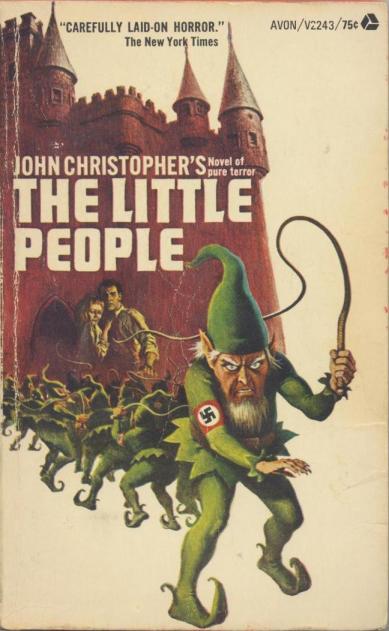
Look at the cover of this book, The Little People.  How could you not want it?  I sure as hell did, and I spent years looking for it.  A gnome wearing swastikas and wielding a bullwhip?  You know that's gonna be good.

A few years ago I attended a large sale put on by a museum.  It was selling off things people donated and items the museum had no use for.  I came across a large box of books.  There were some UFO books in it, a slew of The Planet of the Apes books (which I sold for eBay and made quite a bit on, and The Little People. 

I paid fifty cents for the book.  I would've paid fifty dollars.

Oddly enough, I have yet to read it.  It sits on my shelf in the horror section, much like the Ark rests amongst the crates at the end of The Raiders of the Lost Ark, a treasure to never be seen.  I'll read it someday, but I really wanted it for that cover.  I wanted to know it really existed and wasn't a figment of some delusional person's imagination (including my own). 

I don't know if such a cover could exist today.  The horror market is saturated with good-looking vampires who act politely.  A swastika would be seen by many as an act of war.  Therefore, this book will stay in my collection until forcibly removed, as I'd hate to lose it to some asshole who donates it to a museum.  Things such as this should never be lost to the dustbin of history.

Saturday, October 9, 2010

Monster: The American Psycho Story

"Oh, you're reading that?" is the answer I response I got when a lady asked what I was reading.  I was working in the Eureka, CA Pleasure Center, and she had stepped in to buy who knows what (probably a Pocket Rocket).  She asked what I was reading, and I held up the cover for her to see.  It took a moment because, as you can see here, the title is kind of broken up, and Ellis' name is the same size and in the same font as the title.

Her reaction to my reading of American Psycho told me two things: she had heard of the book and she had never read it.  Yes it is a nasty affair full of sordid images and dastardly deeds.  It is not, however, a full-on misogynistic how-to manual for dealing with women.  The look on her face told me she believed otherwise.

What she, and many others missed, is that like Fight Club, American Psycho isn't primarily about the violence.  It is about consumer culture and what it does to us.  Ellis' yuppie serial killer cannibal Patrick Bateman has all those things that are supposed to make us "happy."  Money.  Women.  Expensive toys.  A good job that he doesn't even need.  Yet he feels isolated and wants nothing more than to fit in.  Towards the end of the book he is losing touch with reality at such an alarming rate that readers can't even tell if the crimes he committed are real (again, much like Fight Club).  It's not a novel about killing women.  It's a novel about culture killing us.

Despite that, controversy lives on.  Some countries only allow it to be sold if it is shrink-wrapped, and only then if you are 18 or older.  (Hell, I want teens to read this.  By the time they reach adulthood the sticky rapist hands of consumer culture are already firmly around their throats.)  Some continue to say Ellis hates women.  I think a far more simple truth, and one that is more disturbing, is that Ellis, when writing this, hated himself and what he was becoming.  He has alluded to that in interviews.  If we accept that answer, though, we have to start seeing all those trappings in ourselves, and that is a very uncomfortable position to be in.  Does that make us just as insane as Bateman?  No.  Bateman is exaggerated for effect.  It does make us understand him better, though, and that is one thing people really hate doing -- understanding the monster.  Once you understand them a bit better, you stop hating them as much.

Bateman wanted to relate to people, but had no idea how to do it, and he ended up killing them (maybe) and doing all sorts of awful tortures.  By destroying them, he was destroying the things he hated about himself in an effort to finally get to that oft-praised plane of self-actualization that is essential to personal happiness.  He was too ill-suited to reach that, however, and went mad (or was mad the entire time).

The end result is not an attack on women but an attack on our current value system.  It's no wonder certain people ignored that and went for the obvious.  We have become so attached to this thing called consumer culture that we can't even recognize valid criticisms of it.  Or we are scared that by recognizing them we question our own existence.  Either way, the attacks on Ellis' work were unwarranted and misguided at best.  At worst they were hypocritical and juvenile.  Peter Sotos he ain't.

Wednesday, September 29, 2010

God and the State

God and the State, Mikhail Bakunin's dissection of the church, government and socialism, is standard in any anarchist's library.  I know plenty of atheists and political science majors who have read it, as well.

At this stage in the game of life, you would think most people with any sort of governmental mistrust and those who question the authority of religion would have at least given this a glance.  Yes, it's incomplete (Bakunin died before he could finish it, and it is published that way), but it is one of the more influential books on the subject.  The foundations of the current anarchist movement are laid here.  The argument against the church is made clearly ... more clearly than a lot of the atheist movement's own literature (which, in its fervor, gives organized religion more power credence than it has on its own).

In other words, this should be standard reading for those who question the status quo.  What I have found is that it is not.

I can't really blame "free thinkers" for not knowing about the book, let alone reading it.  While referenced in plenty of other books on political history and theory, it is far from a household name.  You would really only have a working knowledge of it if you read a lot of anarchist history or read a lot of political theory.  Most of the people I know who question the order of things get their knowledge through The Daily Show.  (Which is on par with those who only get their knowledge through Fox.)  Few seek out anything really in-depth.  Fewer still seek out books published in 1882.  That doesn't make it any less historically important, however, and not just to anarchists.

 With America becoming even more polarized (something that seemed almost unimaginable six years ago), this book's message could not be more timely.  It teaches one how to critically challenge those in authority, and it sets the basis for the not only the current anarchist movement, but for every current movement that professes a desire to be free from government (including the Tea Party, the members of which would probably gasp if they read it).  Will it change the world?  I'd say it already has.

Monday, September 6, 2010

Jitterbug Perfume

I'm reading, as to be expected by this post's title, Jitterbug Perfume.  It is the first Tom Robbins book I've ever read (I know, I know), and won't be the last.  Everyone who has seen me reading it, and who is familiar with his work, has said it is his best.  I don't have enough history to agree or disagree, but I am enjoying it. 

The circumstances behind me reading this are not something I am going to delve into too deeply.  Only two people really know why this book is so important, but I will say this: It was a gift, and it means a lot.  In fact, it was part of a book exchange.  I presented a gift that seemed to be just as appreciated.

Books always make excellent gifts ... unless you are giving them to someone who reads all of one book every five years because they saw something about it on the news or something.  The ones that are given because they have inspired someone or represent what they think is the finest work in the field are the most special because it isn't just a book you are getting, but a sort of window into the gift-giver's soul.  When I give Beyond Good and Evil or The Shining, the receiver is getting a glimpse into the philosophy I live by and the book that made me want to be a writer.

If I give Daredevil: Born Again they are getting the trade paperback that made me realize that I wanted to write something other than horror.  The Preacher and Lone Wolf and Cub series are given because I think they are two of the greatest stories ever told and represent values I think are important (truth, honor, friendship and revenge).  Pranks is another that showcases my philosophy.

The point is, books can be far more than just words or images on paper.  They are the mixed tapes you used to make for a loved one ramped up to the nth degree.  That's what makes them special (the same can be said for a movie or album that particularly inspired someone).  They are, in the end, far more than gifts, and that's why the right book at the right time can do far more than a gift certificate or a "I thought you would like this because it has blood in it" type of thing.  Think about that the next time you want to give someone special something.  Give them something that made you what you are.  The results can be amazing.

Wednesday, July 21, 2010

Cult Killers -- A Frenzied Bloodbath of Exploitation!!!!!!!

Everything about Cult Killers screams exploitation true crime.  From the blurb on the book ("Their secret rituals always end in death!") to the fact that the cases are taken from "the files of True Detective magazine."  All of it has a ring of sensationalism to it.  Still not convinced?  Here are some of the pieces: "Occult Crime: Terror for the Innocents!," "Satanist Offered a Human Sacrifice," "'Skinheads' 'Boot Party' 'Bloodbath!,'" and my favorite, "Six Lovely Girls for Satan's Flesh Eaters!"

Satan's Flesh Eaters would be a great name for a band.

I'm actually rather picky when it comes to true crime books.  I do, however, have a soft spot for the trash Pinnacle used to print (and perhaps still does).  This book was originally published in 1984, which is when I bought it.  Even then I knew skinheads weren't a cult, but that didn't stop editor Rose G. Mandelsberg from including them.  (Maybe it had something to do with her last name.)

I read this book once and promptly filed it away.  Not for research purposes, but for laughs.  I figured there would be a time when I'd want to crack open its pages again and be stunned by Satanists throwing babies under trains or something.  If I sold it, I figured it would be hard to find again, too, as they quickies have a way of disappearing.

So it sits on my shelf, with a host of others, waiting to be reread.  That is ... if the Satanic skinheads don't get me first.

Sunday, July 18, 2010

John Waters

John Waters is, of course, best known for his films and appearance on The Simpsons, but he's also an author, and I have a few books by him and about him.   He's one of those guys who is fascinating in almost every aspect, and little of it has to do with his films.
I have mixed feelings on his movies.  Some I like quite a bit, and others kind of leave me flat.  I don't even own any of his movies, but I do own his books.  That alone is strange for me, as I usually try to keep a DVD library of anyone in my print library, too.

I don't have every book by or about Waters, though it is a goal of mine.   Most are pretty easily obtainable, and every single one I've read has been entertaining.  Whether he's covering his underground filmmaking in the early days, going to see the Care Bears movie solo, or yelling at abortion demonstrators, Waters has this way of saying things that cuts right to the heart of matters.  He understands this ridiculous culture we are knee-deep in, and he can dissect it like a drunk surgeon.

In the future, Waters' name will be remembered as one of American culture's greats.  Many may hate him because of his films (or his open homosexuality), but few can deny his observations.  Even the mainstream has grown to like him (a move that I think helped to dumb down his films).

Even if don't appreciate the man's cinematic works, you should at least give his books a try.  Not every essay will appeal to you, and some may righteously piss you off, but you will laugh, and you will think, and I'm sure one or two of you may actually check out the works that made him famous.  (If you do, I personally like Pecker and Female Trouble, but that's just me.)

Sunday, July 4, 2010

Atlas Shrugged and Stuff

Ayn Rand.  Her name alone is enough to inspire either testicle curdling fear or respect.  I respect her, though I don't often agree with her religious faith in the power of capitalism.

One of Rand's most well-known books is the mammoth Atlas Shrugged.  It is an incredible work of literature that is full of passion and actually comes across as a working manifesto for Rand's philosophy of objectivism.  (Look it up if you want to know what it is, or you can read this book or Capitalism: The Unknown Ideal.) Unlike most books that would attempt such a thing, it works as both.

I don't agree with everything Rand espouses.   I think that if capitalism really remained true to her ideals we may actually be better off in some ways, as the capitalism we have now (exploitation across the board, corporations at the government tit, lack of ethics) is really, to quote MDC, cannibalism.  That said, I still enjoy her work and find her passion for her beliefs to be amazing.  She was an active promoter of ego (and while she stated she was not primarily an advocate of capitalism, she definitely promoted the ideal), and she hated things like anarchism (which to me is the ultimate in egoism combined with a shared sense of ecological well-being) and socialism.  I believe that if she were alive today she would damn all capitalist and call Wall Street a whiny bunch of cokehead cry babies who can't control themselves even when they do themselves harm.

I know people have a hard time with Rand.  That's a given.  Her books are long, they require an intellectual investment, and you can disagree with her ideals.  Disagreeing is different than dismissing, however.  To understand her ideals, first you must read them.  She has thought them out.  She has applied meaning to them.  She is not afraid to put them to the test.

Shun her if you will.  Avoid her work if you must.  But don't dismiss her without at least reading Atlas Shrugged.  That would be pure ignorance on your part ... and it would prove her right.  

Saturday, July 3, 2010

Bleeding Out

I'm not one to read my bestsellers.  It's not that I shun them.  Not even close.  It's just that a lot of what I enjoy reading never makes it to any bestseller list.

I had always been interested in Richard Preston's The Hot Zone, mainly because I have an interest in viruses and the like.  That interest never resulted in me picking up the book, though.

Last year someone left a very tattered paperback copy of the book on a table in the kitchen at work.  I snagged it and just got around to reading it.

Fucking terrifying. 

Not terrifying in the Stephen King definition, but terrifying in the "holy Hell, this stuff happens and will happen again is there is nothing I can do about it" kind of way.

Ebola Zaire is not something to mess around with under any circumstance.

I could see why this was a bestseller.  It was fast-paced, well-written and targeted a general audience.  It worked in all the ways Leonard G. Horowitz's Emerging Viruses didn't.  (And I actually enjoyed that book, which came out three years earlier than Preston's book.


One of the problems with books about viruses is that there is an almost deer-in-headlights feel you get with them.  You go into them knowing the situation is bad, but you come out of them realizing you had no idea how screwed you were.  Like magic, the wool is lifted from your eyes, and it is a very unsettling feeling.  You have to respect a book that can do that, but at the same time it is mighty frustrating.

I know there are plenty of good books on medical terrors just floating around out there.  Some are fiction, others are not.  I can read about one a year before I go crazy, though.   For the exact same reason I stopped watching ER.  I get paranoid I have or will have whatever the major malady happens to be. 

If there's a better reason to stay away from bestsellers, I'd love to know it.

Sunday, June 27, 2010

The Memories of Private Parts

I used to be a Howard Stern fan (not that I am not a fan anymore, I just don't have access to his show).  I've always respected and supported his battles with the FCC, and while I haven't always agreed with what he's said, I've always supported his right to say it.

When Private Parts came out I was in Southern California, biding my time until I could move to Northern California and get the hell away from all the plastic viruses that make up Los Angeles and its outskirts. 

When that fateful day finally arrived, I got into the back of my aunt's car, and away we went, though I was given a gift for the ride.

Howard Stern's book was devoured on that car trip.  Cover to cover I read it and laughed aloud countless times.  (I haven't read it in years, but I seem to recall a passage about cutting Juliette Lewis' head off, which I'm all for.)  It was funny, and it was well-written.  And let's not forget compelling.  It was Stern's life laid bare; the ultimate underdog story.

Stern's life since then has had its ups and downs.  I remember actually being quite sad when I heard his marriage was ending, though I suppose it was only a matter of time.  Thinking back those memories makes me want to read the book again, though I just watched the movie again recently, so it will be some time before I turn back to it.

Say what you want about Stern (and plenty have).  He taps into something with people.  He is offensive, rude and often talks out his ass, but he is also truthful and unflinching.  He says things most people would never even think of, and he pushes people to their limits.  As a free speech junkie, I applaud that sort of action.  As a writer, I appreciate it.

If I could publish a book that sold half as many copies as Stern's book did, I'd be a happy man.  If I could fuck with the FCC as much as he did, I'd die with a smile on my face.

You may hate him, but what have you done?

Thursday, June 24, 2010

Beyond All Men's Fears

I don't real a lot of philosophy.  Frankly, I think most of it is shit.  Nietzsche's Beyond Good and Evil, however, is one book I keep on my shelf and refer back to probably far too often.

I was introduced to Nietzsche when he was referenced in an interview with Henry Rollins.  I was young and checked out the philosopher's writings, and for some reason it stuck.  If you know me and have read Nietzsche I don't think that's such a huge surprise. 

As I mentioned, I think most philosophy is shit.  It is either overly introspective to the point where it feels fake, or it isn't introspective enough.  Most of it, I feel, asks the wrong questions and comes to flawed conclusions.  Not so with Nietzsche.  His writing comes across as pure.  I know he is anything but pure, however the meaning is there.  (And that meaning has been exploited by others in not the most befitting manner.)

I don't even ever see myself buying many other philosophical works other than by Nietzsche.  I don't have a special spot on my shelf for philosophy that has anything but Nietzsche's works in it.  At the end of the day, it is what I turn to for quotes, inspiration and guidance.  Some may like Kant or Telesius.  Me?  I'll stick with my German every time.

Saturday, June 12, 2010

Writing For the Masses

I recently finished Black Flame: The Revolutionary Class Politics of Anarchism and Syndicalism and decided I wanted to write a review of it for Associated Content.  I figured this might be the place to get the biggest audience of people who would never seek this book out on their own.  There's one problem, though: How do you write a review for the masses about a subject that most people have either no knowledge of or are totally misinformed about?

It is a lot harder than it sounds.

A vast majority of people get their views on anarchism strictly from the local news, which has never covered it correctly.  Even those in unions, which exist thanks to the past fights of the anarchists, have little knowledge of their group's anarchist roots.  Combine that with a nearly 400 page academic book and you have a situation where you almost can't write for a general audience.

I want the review to make the book sound appealing to those who would never consider reading it.  People interested in anarchist politics would have either already read it, or they would have it on their radar.  That isn't the audience I want.  I want the people whose knowledge of books is what they see in Borders.  So, in order to do that, I have the write the review as simple as possible (no detailed analysis of issues such as the role of gender in anarchist movements in Japan in the 1930s), while at the same time making sure the book's complexity is highlighted as to not mislead anyone.  I have to write the review to ensure that anyone who reads it and would be remotely interested in the subject matter will want to keep the book on their radar.

It's not often where you see books this specialized reviewed in venues that are designed to appeal to general audiences.  Usually they are given page space in journals and on specialized web sites.  That's because of the difficulty in writing such a review for general audiences.  It is almost an exercise in failure, and nobody wants to pay for that.  Luckily, Associated Content pays by page views, so it is up to the author to make his or her work appealing enough to get paid.

I don't know if I'll succeed.  I have a rough draft done, and I'm liking it so far.  It is simple enough not to bore, and it gives readers a good idea if they'll want to pick up the book or not.  Of course, my goal is to get people to read it, but I'm not hopeful enough to think someone is going to pick this up as a light summer read.  (That's why the Twilight series exists.)  But if I can get just one person to give it a shot, then I've done my job.

Tuesday, June 8, 2010

A Visual Exploration of Fetish

I'm a big fan of photography books ... when it's a subject I enjoy.  Doris Kloster's Demimonde: A Visual Exploration of Fetish is one of those books.  Not that I'm the kind of guy who likes to dress up in leather chaps or be with a woman in some uniform (unless it's an SS uniform -- for some reason women are sexy in those, and I'm no Nazi sympathizer).  I just happen to enjoy the visuals, and this book captures the fetish aspect quite well.  You've got prostitutes, spankings, Catholic school girls, and so on.  I wrote a positive review of it for Amazon four years ago, and I stick by it.  Yeah, it's a coffee table book, but not one you want to leave around for your mother (unless that's your fetish).


Few people seem to understand that costumes and erotic photography can actually be art.  They see somehow bound and gagged and immediately think porn.  Yes, it can work as porn, much like the Victoria's Secret catalog provides masturbation material for thirteen-year-olds without the Internet or friends.  It goes beyond that, though, and isn't meant to be a self-pleasure aid, though I'm sure the photographers wouldn't mind if it were used as such.


Right now I'm working on a manuscript where one of the characters is a fetish photographer.  I've known a few of those, along with the models they use.  They are always interesting people.  I would even say that most of the ones I've met are fairly well-grounded, but open about their desires and their own fetishes.  Some look at this as a job.  Some are exploring their passions.  All of the photographers I've met treat it as art, while only some of the models share that sentiment.


I have book shelf space dedicated to art books and erotica.  (Oddly enough, there is only like one category separating them.)  Kloster's book is firmly in place in the art section.  One friend who happened to glance through it said it should definitely be in my "porn spot" (which is a highly inaccurate description).  We argued a bit about it until she admitted that she did find the pictures kind of a turn-on, and that's what made her think they deserved to be in the "porn" section.


Some people will never get it.  Some people will get it all too well.  Either way, I'm not moving it.

Saturday, June 5, 2010

AK Press Sale!

I received this e-mail.  Seems like a good time to stock up.


In This Email Monthly Review Sale Discounted AK Titles Forthcoming AK Titles Friends of AK Press Quick LinksAK Press - HomeNew Titles at AK PressDirt Cheap Sale ItemsFriends of AK
Revolution by the Book (AK Blog)
Save on Monthly Review Books All Month!
We had so much fun with last month's Mayday Spectacular sale, we've decided to keep up the discounting action. So from now on, we're going feature a different publisher each month and put ALL their books on 25% discount for the whole month. That way you'll get a sense of all the great publishers we work with, and you'll save money at the same time! Doesn't that sound fun?

So, to kick things off, our featured publisher for the month of June is Monthly Review Press-an independent socialist publisher, and the publishing arm of Monthly Review magazine. They're known for their books on political economy, history, ecology, and labor, among many other essential topics.

Check out all the Monthly Review titles, in their discounted glory, or read on for a few highlights...
Monthly Review: Recent & Recommended  [Image]The ABCs of the Economic Crisis: What Working People Need to KnowMichael D Yates & Fred Magdoff
Sale price: $8.96 (list price $11.95)
The economic crisis has created a host of problems for working people: collapsing wages, lost jobs, ruined pensions, and the anxiety that comes with not knowing what tomorrow will bring. Compounding all this is a lack of reliable information that speaks to the realities of workers. In this short, clear, and concise book, Fred Magdoff and Michael D. Yates explain the nature of the economic crisis as a normal and even expected outcome of a thoroughly irrational and destructive system. No amount of tinkering with capitalism can overcome the core contradiction of the system: the daily exploitation and degradation of the majority of the world's people by a tiny minority of business owners. This book is aimed primarily at working people, students, and activists, who want not just to understand the world but to change it.

For more background on the financial crisis from Monthly Review, see also The Great Financial Crisis. [Image]Anarchism: From Theory To PracticeDaniel GuérinSale price: $10.50 (list price $14.00)
A classic introductory book on anarchism, with a strong Marxist flavor. Excellent both on the intellectual substance of anarchism and its actual practice through the Bolshevik Revolution, the Spanish Civil War, the Italian Factory Councils, and workers' self-management in Yugoslavia and Algeria. With an introduction by Noam Chomsky. [Image]Discourse on Colonialism
Aimé CésaireSale price: $10.50 (list price $14.00)
Césaire's work, crucial to the anti-colonial struggles of the 50s and 60s, now haunts us again. His questions about the role of imperialism and slavery and of concepts like the "savage" or the "primitive" as central to the construction of "civilization," of the West and of progress remind us that the carnage in Africa, Asia, and the Americas which is our history is not past; it is lodged deep in the heart of Western cultures. As Césaire said, "It is equally necessary to decolonize our minds, our inner life, at the same time we decolonize society." [Image]Eurocentrism: Modernity, Religion, and Democracy, A Critique of Eurocentrism and Culturalism
Samir AminSale price: $13.46 (list price $17.95)
Since its first publication twenty years ago, Eurocentrism has become a classic of radical thought. Written by one of the world's foremost political economists, this original and provocative essay takes on one of the great "ideological deformations" of our time. Rejecting the dominant Eurocentric view of world history, which narrowly and incorrectly posits a progression from the Greek and Roman classical world to Christian feudalism and the European capitalist system, Amin presents a sweeping reinterpretation that emphasizes the crucial historical role played by the Arab Islamic world. Throughout the work, Amin addresses a broad set of concerns, ranging from the ideological nature of scholastic metaphysics to the meanings and shortcomings of contemporary Islamic fundamentalism.

Also by Samir Amin, from Monthly Review: The World We Wish To See. [Image]Open Veins of Latin America: Five Centuries of the Pillage of a ContinentEduardo Galeano Sale price: $13.50 (list price $18.00)

The best single volume on 500 years of exploitation and resistance of Latin America's "open veins." Rather than chronology, geography, or political successions, Galeano has organized the various facets of Latin American history according to the patterns of five centuries of exploitation. Weaving fact and imagery into a rich tapestry, Galeano fuses scientific analysis with the passions of a plundered and suffering people. This classic is now further honored by Isabel Allende's inspiring introduction.

For another Galeano classic from Monthly Review, check out Days and Nights of Love and War. [Image]The Structural Crisis of CapitalIstván MészárosSale price: $20.21 (list price $26.95)
In this collection of trenchant essays and interviews, István Mészáros lays bare the exploitative structure of modern capitalism. He argues with great power that the world's economies are on a social and ecological precipice, and that unless we take decisive action to radically transform our societies we will find ourselves thrust headfirst into barbarism and environmental catastrophe. Mészáros, however, is no pessimist. He believes that the multiple crises of world capitalism will encourage the working class to demand center stage in the construction of a new system of production and distribution designed to meet human needs rather than serve the relentless pursuit of profit.

Also by István Mészáros, from Monthly Review: The Challenge and Burden of Historical Time. [Image]The Taming of the American Crowd: From Stamp Riots to Shopping Sprees Al SandineSale price: $14.21 (list price $18.95)
The history of the United States has been largely shaped, for better or for worse, by the actions of large groups of people. Rioters on a village green, shoppers lurching about a labyrinthine mall, slaves packed into the dark hold of a ship, strikers assembling outside the factory gates, all have their place in the rich and sometimes tragic history of the American crowd. This unique study traces that history from the days of anti-colonial revolt to today's passive 'colonized crowds' that fill our sports arenas, commercial centers, and workplaces. In clear and lively prose, Al Sandine argues for role crowds have played in securing greater democracy, civil rights, and free speech. But he also investigates crowds in their more dangerous forms, such as lynch mobs and anti-immigrant riots. [Image]When Media Goes to War: Hegemonic Discourse, Public Opinion, and the Limits of DissentAnthony DiMaggio Sale price: $14.21 (list price $18.95)
In this fresh and provocative book, Anthony DiMaggio uses the conflicts with Iraq and Iran as his touchstones to probe the sometimes fine line between news and propaganda. Using Gramsci's concept of hegemony and drawing upon the seminal works of Noam Chomsky, Edward Herman, and Robert McChesney, DiMaggio enlightens readers about issues essential to the struggle for a critical media and a functioning democracy. If our newspapers and television news programs play a decisive role in determining what we think, and if what the media give us is largely propaganda in support of an oppressive and undemocratic status quo, then it is incumbent upon us to make sure that they are responsive to the majority and not just the powerful and privileged few.

Also about the media, from Monthly Review: The Language of Empire, The Political Economy of Media, and The Problem of the Media. Featured AK Press Titles: 50% Off! [Image]Each month we also bring you a new selection of featured AK Press backlist titles at an enticing 50% discount! Here are the new featured titles for June:

Black Flame: The Revolutionary Class Politics of Anarchism and Syndicalism, CounterPower Vol. I
Michael Schmidt & Lucien van der Walt
Sale price: $11.50 (list price $22.95)
Critical Mass: Bicycling's Defiant Celebration
Edited by Chris Carlsson
Sale price: $9.50 (list price $18.95)

1936: The Spanish Revolution
The Ex
Sale price: $12.50 (list price $24.95)

Igniting A Revolution: Voices in Defense of the Earth
Edited by Steven Best & Anthony J. Nocella II
Sale price: $11.00 (list price $21.95)
Real Utopia: Participatory Society for the 21st Century
Edited by Chris Spannos
Sale price: $11.00 (list price $21.95)

Anarchism in America DVD
Edited by Steven Fischler & Joel Sucher
Sale price: $10.00 (list price $19.95) Forthcoming AK Press Titles: 25% Off! [Image]We've been busy around here lately, getting LOTS of new AK Press books sent off to the printer... and we hope you'll be as excited as we are about the results. Check out the next few books that are coming out from AK Press, and preorder yours today! We'll bill you and send your books as soon as they arrive in our warehouse from the printer.
Wasting Libby: The True Story of How the WR Grace Corporation Left a Montana Town to Die
Andrea Peacock
Preorder now for $11.95 (list price $15.95)
Dispersing Power: Social Movements as Anti-State Forces
Raul Zibechi
Preorder now for $11.95 (list price $15.95)
Uses of a Whirlwind: Movement, Movements, and Contemporary Radical Currents in the United States
Edited by Team Colors Collective
Preorder now for $14.95 (list price $19.95)
Sparking A Worldwide Energy Revolution: Social Struggles in the Transition to a Post-petrol World
Edited by Kolya Abramsky
Preorder now for $16.50 (list price $21.95) Become a Friend of AK Press! [Image]Support anarchist publishing! To thank you for your monthly contribution of $25 or more, we'll send you a copy of every new AK Press title hot off the press—plus you'll get a 20% discount on anything we sell, anytime! With so many great titles at the printer, there's no time like the present to sign up as a Friend of AK.
Sign up now and get a stylish tote bag featuring the new Friends of AK logo designed by Josh MacPhee. If you're already a FoAK, just refer someone else, and if they mention you when they sign up, you'll both get a tote bag. And that's not all-if you keep referring more people after your first, you'll get a $20 AK Press gift certificate for each additional new FoAK you sign up!
 

Sunday, May 9, 2010

The Monster Show

For those interested in cultural studies of horror  (a subject I am utterly fascinated by), David Skal's The Monster Show: A Cultural History of Horror is a great starting point. 

Horror movies and other related media have often mirrored the political and social times we live in, and Skal's book takes an in-depth look at the issues that shaped America as they were reflected in our horror films. 

AIDS, birth control, Pearl Harbor, Nazis, mind control and more are tied into Frankenstein, Rosemary's Baby, American Psycho and scores of other horror notables.  Just the link between AIDS and vampire-related horror films is fascinating in its own right. 

Far too many people dismiss horror films as nothing more than juvenile entertainment meant to desensitize impressionable youth to the affects of violence.  Anyone reading this book would be hard pressed to make that argument with a straight face.

At just around 400 pages (and there are photos), this is a little more than a light read, but it is not written like your average text book (though I could see a college class using it as such).  It's a bit more informal, which is where some of my complaint lies.  I would love to have seen the author go into an even deeper examination of things, as I think the book could have easily been four times its size.

As it is, it is still a fine read that I've gone back to reference over the years.  Good stuff for horror junkies and sociology majors whose taste runs to the dark stuff.